
RICORDANDO UNO SPETTRO CHE FLUISCE SENZA BOCCHEGGIARE NEL LIMBO
A Venezia, dal 7 Maggio al 1 Novembre, presso la Scoletta dei Battioro e Tiraoro, è visitabile una mostra di Arch Hades, dal titolo Return. Lei spazia fra molteplici discipline: la pittura, l’installazione, la performance ecc… Esteticamente, interessa un esistenzialismo tramite cui l’arte è nostalgica rispetto alla fuggevolezza dell’idealismo, nella coscienza. La fenomenologia dà un orientamento sull’approccio verso qualcosa all’infuori. L’arte desidererebbe che s’immortalasse la realtà. Per arrivare a questo, c’è l’immaginario che circuisce. Ma, quando s’astrae una realtà, la conoscenza richiede la memoria. Alla fine “spiace” che il tempo passi. Chi rammemora prova a circuire un orientamento diretto ma “con le toppe”. Subentra la reinterpretazione, che nell’arte fra l’altro impedisce di cedere alla “piattezza” d’un funzionalismo momentaneo, come per l’artigianato. Immortalando, nel corso delle varie epoche, si prova nostalgia con “onorevolezza”: per un ideale di verità, universalmente, che sbatte contro la caducità personale. Modernamente c’è la sensibilità di preservare i monumenti. Arch Hades in aggiunta scrive poesie. Queste visualizzeranno meglio la brevità della vita, la quale tuttavia potrà intensificarsi, con la sentimentalità.
Per il progetto artistico dal titolo Serie di confessioni, Arch Hades ricorre alla forma del biglietto. Quando si ricorda dal passato, fatalmente manca la vividezza del dettaglio. Arch Hades è partita da una performance. Lei cercava l’ispirazione giusta per scrivere liricamente; e tuttavia finiva per stropicciare la carta. E’ nota la paura della pagina bianca. Ci si scervella continuamente, senza mai accontentarsi delle “idee sparse”, che non portano ad una conclusione. Alla fine potrà arrivare un’intuizione, improvvisamente, da curare. E’ il contraltare per qualcuno che “c’imbocca”, quando noi non ricordiamo più troppi dettagli, da un evento condiviso con lui. Arch Hades mantiene la stropicciatura perfino “sbloccandosi”, con le parole giuste da scrivere. Il laboratorio dell’artista è parte dell’opera in mostra; diversamente gli oggetti comuni hanno già un loro significato, che non necessita di riconfigurarsi. Esteticamente, la fibra di vetro consente di levigare la trasparenza: lo stesso accade rammemorando. E’ percepita la dialettica fra l’intenzionalità ed il capriccio quando la resa artistica non ci soddisfa mai completamente. Per la raccolta dei rifiuti serve il compattatore. L’attività intellettuale è comunque di riciclo, a causa dell’ermeneutica. Arch Hades predilige la scrittura in corsivo. Una benna in parte preserva ed in parte graffia. I testi esposti nei biglietti ripropongono il tema del ritorno. Questo a volte “si stropiccia” mediante il tira e molla, come in amore.
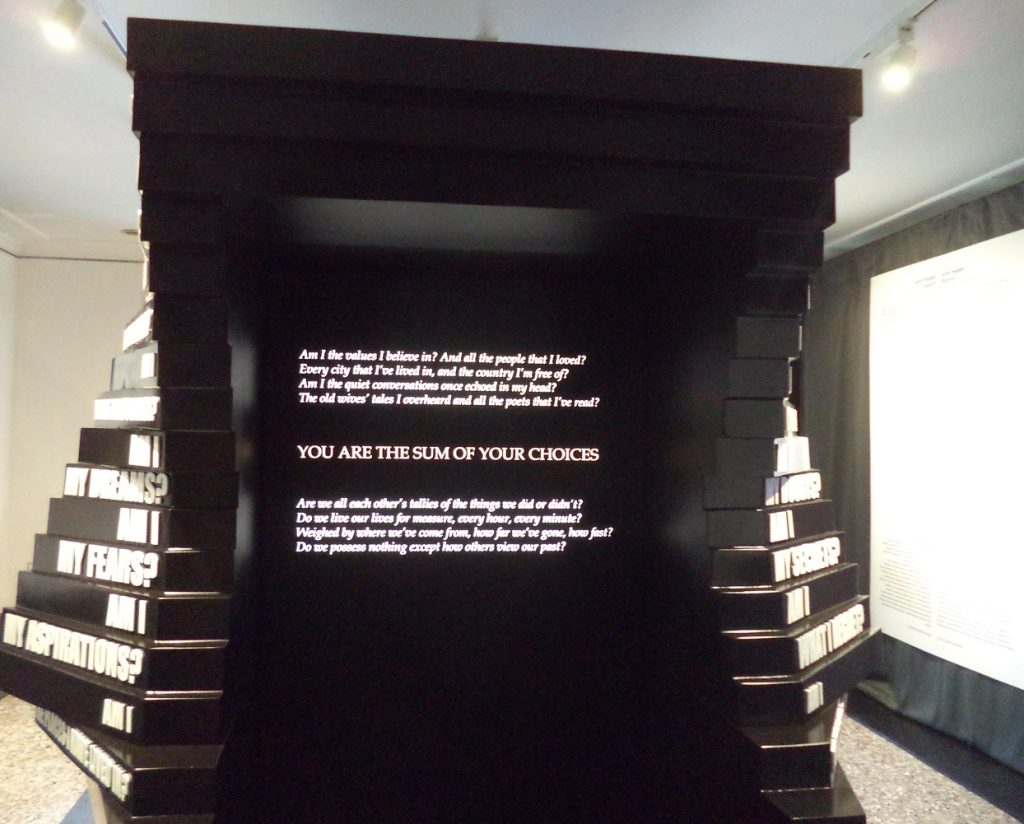
Nell’installazione dal titolo Sfinge, ad Arch Hades esteticamente interessa la memoria episodica. Ci sono molte scritte in forma di domanda: chi pone questa, già deve conoscere una piccola parte della possibile risposta (pena l’incomunicabilità totale). L’allestimento della Sfinge distorce il copricapo mediante gli scalini. Si dice che gli Egizi costruissero i loro monumenti in base all’orientamento con le stelle. Arch Hades conosce la statistica psicologica per cui taluni eventi si ricordano meglio di altri, soprattutto da un trauma. Lei espone un’installazione nera, dove le scritte bianche si rispecchierebbero, falsando la luminosità, sugli scalini che non possono rimanere panoramici. La loro domanda riguarderà una ferita da riqualificare. Di norma la Sfinge ha il corpo del leone, le ali dell’uccello ed un volto umano. Già da Platone ad Aristotele, l’anima è percepibile in eventi diversi, per suscettibilità, spontaneità o razionalità. La Sfinge di Tebe costitutiva un ostacolo doganale. Il visitatore che non avesse risolto il suo enigma, addirittura sarebbe stato strangolato (esasperando il nervosismo per lo stropicciamento, dall’estetica di Arch Hades). Mancava la “generosità” oracolare, utile da recepire per vivere meglio. La Sfinge a Tebe poneva al visitatore un indovinello, dunque un rispecchiamento oscuro. Nell’arco d’una vita, per un uomo è probabilissimo fallire riguardo la maggioranza dei propri progetti. Ciò non toglie la necessità che il “mosaico” delle esperienze passate sia riassumibile in un senso per il presente, oltre il “muro” del destino. Le scritte dell’installazione portano delle domande esistenzialistiche. Noi valuteremo la nostra scala di risposte: tra le alzate per la soddisfazione d’un successo (tirando un sospiro di sollievo) e le pedate al fallimento su cui rassegnarsi (se la situazione realisticamente ci sovrasta). Al teriomorfismo l’immagine del leone sembra quella più giudicante, per l’intensità del potere rispetto alla catena alimentare.
Nell’installazione dal titolo Piovere, Arch Hades ha inserito una propria poesia. In questa, s’immagina che qualcuno alla deriva si riversi in qualcun altro. La foce è un sostegno che “intorpidisce” per dipendenza. Ad un amico non piace che noi lo ricordiamo solo nel momento del nostro bisogno; al nostro partner noi non domandiamo di cercare solo un rimedio temporaneo. L’installazione presenta una nuvola superiore. Essa in natura è un sostegno per la “tranquillità” dell’aria tramite cui “s’intorpidisce” la dipendenza dal vento. Il testo poetico appare nelle “spade diluvianti”. Esteticamente, uno stream of consciousness va curato con le “tacche” della punteggiatura. La nuvola superiore avrebbe dei ganci alla “fulminazione” delle lettere, con la complicità del tono nero, da inchiostro. Col diluvio, nelle spade confluirebbero le proposizioni. A terra c’è l’ineluttabile pozzanghera, che rifletterebbe come uno specchio per i soli contorni, con lo scarabocchio al posto della figura. La spada del diluvio ovviamente si percepirebbe a penna. Arch Hades cita gli orologi sciolti nel surrealismo di Salvador Dalì, dal dipinto che s’intitola La persistenza della memoria. Alcuni eventi che noi abbiamo vissuto sono talmente intensi da sfuggire a qualunque calendarizzazione. Quelli valgono percependosi come le macchie indelebili.
Per l’installazione dal titolo Ritorno, Arch Hades ha dipinto ventidue pannelli, che sono stati esposti fra le pareti distorcendo un tradizionale trittico. Le figure umane appaiono nude, ma con la pelle da percepire al proprio “spettro”. Si citano i Quadri delle facoltà, che Gustav Klimt dipinse e che poi andarono perduti durante la Seconda Guerra Mondiale. Esteticamente, pare che ad Arch Hades interessi lo spettro d’una pelle che deve fluire, senza limitarsi a boccheggiare, nell’ade. Nell’eternità, la semplice durata del tipo presente / passato / futuro si dissolve. La potenza dell’imbuto che attira a sé i corpi è tale da infiammarli, per l’attrito. Amando, la nudità dà l’illusione di fondersi col partner. Molti corpi sono stati dipinti “infiammandosi” a livello del sangue, sia arterioso sia venoso, mediante i toni del rosso e del blu. Con Platone, un ricettacolo di materia organica dovrà rimodellarsi in una “carreggiata”, laddove la terra da raggiungere all’orizzonte manterrà il miraggio per una sospensione nel vuoto aereo. Esiste l’iconografia del giardino paradisiaco alla mitezza come quella d’un inferno per il deserto all’escursione termica. Arch Hades avrebbe citato pure il Ratto di Proserpina, da Gian Lorenzo Bernini, per una scultura al barocco, e dove mitologicamente le stagioni sono gli spettri della natura. Forse il suo colonnato per la Piazza San Pietro al Vaticano crollerebbe da un colpo di bowling. Ma non sapremo mai quanto la boccia, tornando indietro, avrà sviluppato il boccheggiamento in infiorescenza. Il blu ed il rosso sono i colori delle ortensie, che mutano in base al pH del suolo.
A Venezia, noi consideriamo l’installazione dal titolo Corteccia mormorante (citando un brano orchestrale di Richard Wagner). Esiste anche una monumentalità in natura. Arch Hades precisamente espone una serie di alberi in fibra di vetro, con gli altoparlanti nascosti nei tronchi. La naturalità è demandata alla corteccia, tramite la quale la vitalità “si fulmina” istintivamente. Per ricordarsi qualcosa, bisogna accettare di conoscere un io soggettivo. L’installazione ha degli squarci “fulminei”, sul tronco. L’autocoscienza sorge nella corteccia cerebrale. Gli alberi di Arch Hades vivrebbero tramite una linfa addensata dal diaframma, spiritualmente, poiché si recita una sua poesia. Questa invita a liberarsi dei ricordi senza spezzarli. Esiste la riconversione dei tronchi, nel tempo, mediante i loro anelli al giro e rigiro. Soprattutto bisogna scartare le cicatrici esistenziali. La trasparenza del vetro si materializzerà ai ventagli per l’arieggiamento, oltre le toppe ammuffite. Sulle cortecce dei tronchi possono spuntare i licheni, ad esempio.
REMEMBERING A SPECTRE THAT FLOWS WITHOUT GASPING IN THE LIMBO
In Venice, from 7 May to 1 November, at the Scoletta dei Battioro e Tiraoro, we can visit an exhibition of Arch Hades, called Return. She ranges from many disciplines: the painting, the installation, the performance etc… Aesthetically, the interest is about an existentialism through which the art is nostalgic compared to a fleetingness of the idealism, in the consciousness. The phenomenology gives an orientation on the approach to something outside. The art would wish that the reality would be immortalized. To arrive to this situation, there is the imaginary which entices. However, when we abstract a reality, the knowing requires the memory. Finally we “regret” that the time passes. Somebody, who remembers, tries to entice an orientation which is direct but “with the patches”. A reinterpretation follows; this one in addition prevents the art from ceding to the “monotony” of a momentary functionalism, as for the craftsmanship. Immortalizing, through the different ages, we feel nostalgic “in honourable way”: for an ideal of truth, universally, which bumps into the personal transience. In the modernity there is sensitivity for the preservation of the monuments. Arch Hades in addition writes poems. These would better visualize the brevity of the life, which however could become more intense, with the sentimentality.
For the artistic project called Confessions series, Arch Hades resorts to the shape of the note. When we remember from the past, fatefully the vividness of the detail is lacking. Arch Hades started from a performance. She tried the right inspiration to write lyrically; however she ended up crumpling the paper. We know the fear of the blank page. We rack our brains continually, without ever being content with the “random ideas”, which don’t lead to a conclusion. Finally an intuition could arrive, suddenly, requesting that we take care of it. This is a counterbalance for somebody who “spoon-feeds” us, when we no longer remember too many details, from an event shared with him. Arch Hades maintains the crumpling even “clearing” herself, with the right words that she has to write. The laboratory of the artist is part of the works in exhibition; differently the common objects already have an own meaning, which does not need a reconfiguration. Aesthetically, the fiberglass allows smoothening the transparency: the same happens when we remember. We perceive the dialectics between the intentionality and the caprice when the artistic result does not satisfy us completely. For the garbage collection, we need a compactor. The intellectual activity functions however for a reuse, because of the hermeneutics. Arch Hades prefers the cursive writing. A bucket partly maintains and partly scratches. The texts exposed in the notes propose again the theme of the return. This one sometimes “is crumpled” through a push-pull, as in love.
In the installation called Sphinx, Arch Hades is aesthetically interested in the episodic memory. There are many writings in the form of a question: somebody who poses a question, has already to know a small part of the possible answer (otherwise it happens a total incommunicability). The staging of the Sphinx distorts the headdress through the steps. It is said that the ancient Egyptian built their monuments on the basis of the orientation by the stars. Arch Hades knows the psychological statistics for which some events are better remembered compared to some others, principally from a trauma. She exposes a black installation, where the white writings would be mirrored, falsifying the brightness, on the steps that can not remain panoramic. Their question will concern a wound that we have to requalify. Usually the Sphinx has the body of a lion, the wings of a bird and a human face. Already from Plato to Aristotle, the soul can be perceived in different events, for a susceptibility, a spontaneity or a rationality. The Sphinx of Thebes constituted a customs obstacle. If the visitor had not been able to solve its enigma, even he would have been strangled (exasperating the irritability for a crumpling, from the aesthetics of Arch Hades). The “generosity” of an oracle, useful to be accepted to live in better way, was lacking. The Sphinx of Thebes posed a riddle to the visitor, so an obscure mirroring. In the space of a life, there is a high probability that a man fails about the majority of the own projects. Nevertheless, there is the necessity that a “mosaic” of the past experiences can be summarized in a sense for the present, beyond the “wall” of the destiny. The writings of the installation promote some existentialist questions. We will evaluate our scale of answers: between the risers for a satisfaction from a success (breathing a sigh of relief) and the treads from a failure where we resign ourselves (if the situation realistically dominates us). At the theriomorphism the image of a lion seems the image more judging, for the intensity of the power compared to a food chain.
In the installation called Rain, Arch Hades inserted an own poem. In this one, it is imagined that somebody drifting pours out over somebody else. The estuary is a support which “numbs” for a dependence. A friend does not appreciate that we remember him only in times of our need; we don’t ask our partner to look for only a temporary remedy. The installation presents a cloud, above. This one in nature is a support for the “tranquillity” of the air through which the dependence on the wind “is numbed”. The poetical text appears inside the “swords which pours down”. Aesthetically, a stream of consciousness has to be treated with the “notches” of the punctuation. The cloud above would have some hooks at a “fulmination” of the letters, with the complicity of the black tone, for an ink. With a deluge, the propositions would merge into the swords. On the ground there is an inescapable puddle, which would reflect as a mirror only for the contours, with a scribble in place of the figure. The sword of the deluge of course would be perceived as a pen. Arch Hades mentions the melted watches in the surrealism of Salvador Dalì, from the picture called The persistence of memory. Some events that we lived are so much intense that they escape from whatever scheduling. Those are valid in their perception as indelible stain.
For the installation called Return, Arch Hades painted twenty-two panels, which were exposed between the walls distorting a traditional triptych. The human figures appear naked, but with the skin that has to be perceived at the own “spectre”. We mention the Faculty paintings, that Gustav Klimt painted and then were lost during the Second Mondial War. Aesthetically, it seems that Arch Hades is interested in the spectre of a skin which has to flow, without limiting itself to gasp, to Hades. In eternity, the simple duration of the kind present / past / future dissolves. The power of a funnel which attracts to itself the bodies is such that it burns these, by the friction. Loving, the nudity creates the illusion that we blend with the partner. Many bodies were painted “burning” at the level of the blood, both arterial and venous, through the tones of the red and of the blue. With Plato, a receptacle of inorganic matter will have to be remodelled in a “carriageway”, where the land, that we will have to reach on the horizon, will maintain the mirage for a suspension in the air vacuum. The iconography of a paradisiac garden at the mildness exists, as the iconography of a hell for the desert with the thermal excursion exists. Arch Hades would have mentioned also the Rape of Proserpina, from Gian Lorenzo Bernini, for a baroque sculpture, and where mythologically the seasons are the spectres of the nature. Perhaps his colonnade for the Saint Peter’s Square in Vatican would collapse from a bump at the bowling. But we will never know how much the ball, going back, will have developed the gasping into an inflorescence. The blue and the red are the colors of the hydrangeas, which change on the basis of the pH of the soil.
In Venice, we consider the installation called Murmuring bark (mentioning an orchestral piece of Richard Wagner). Also a monumentality exists in nature. Arch Hades precisely exposes the series of trees in fiberglass, with the loudspeakers hidden in the trunks. The naturality is delegated to the bark, through which the vitality instinctively “is burnt out”. To remember something, we have to accept to know a subjective I. The installation has some “lightning” gashes, on the trunk. The self-awareness rises in the cerebral cortex. The trees of Arch Hades would live through a sap thickened by the diaphragm, spiritually, because one of her poems is recited. This one invites to a liberation from the memories without breaking those. The reconversion of the trunks exists, through their rings for tossing and turning. Principally we need to discard the existential scars. The transparency of the glass will be materialized at the fans for the aeration, beyond the mouldy patches. On the barks of the trunks the lichens for example can sprout.