
Sarah Staton – Abbiamo Stoffa
dal 4 Sep al 5 Oct 2025
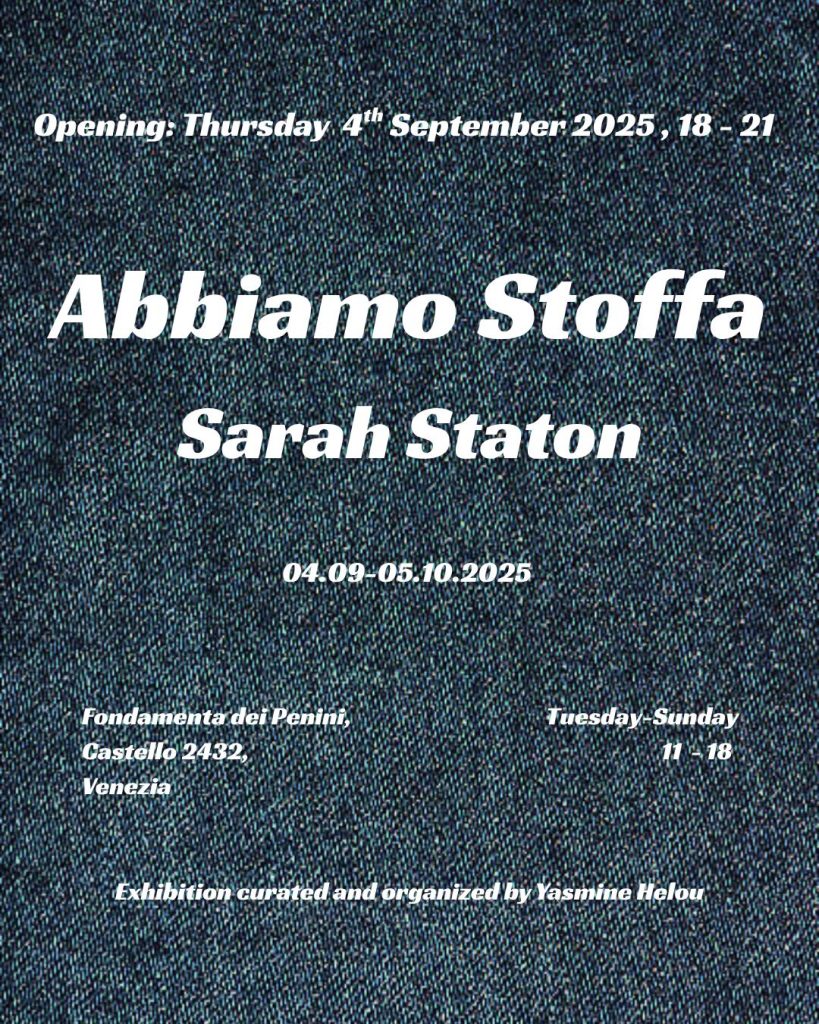
Abbiamo Stoffa is the first solo show of multidisciplinary British artist Sarah Staton in Venice. This site-specific exhibition, envisioned especially for Venice, brings together textile, paint and glass, evoking a textured contemporary paradox betwixt tradition and consumerism, opacity and transparency, monochrome and polychrome. While Staton could in a certain way be associated with the Young British Artists, her signature wit, irony, and conceptual navigation of contemporary art inscribe her research on a global scale, nestled at the crossroads between sculpture, painting, drawing and writing. Letting humorous actions and profound engagement shape her grasp of the world conjuncture, Staton carves her own vision of past, present and future. Although Venice becomes the epitome of world contrasts, it keeps inspiring new perspectives, and it is in this spirit that the works presented here emerge as a contrasted installation, patterned and yet cohesive, amidst dots and letters, denim and paint.
As multiple little glass mass-market figurines are showcased amongst a group of cocktail-shaped sculptures – a metaphor for mass tourism and its homogeneous drive for the “local” turned global – hung on the walls are what could seem at first glance jolly and lively pieces, but are in fact carriers of strong intentions. Not unlike Stefan Zweig used to worry about the “uniformisation” and “monotonization” of the World, Sarah Staton does too. She, however, plays with it bringing up its forgotten particularities. While Laguna (2025) is an impressive picture made of bleached denim, the material could easily recall other cities associated with the fabric, such as Nîmes, with “sergé de Nîmes” from where the word originates, and of course, the invention of jeans, in what used to be another Sea Republic, Venice’s ultimate rival, Genoa, where huge altar pieces were painted onto blue sail cloth. In this sense, Laguna extends Staton’s ongoing series of “anti-paintings,” extracting color directly from the denim to create texts and images. In many ways it is a reflection on today’s industrialisation of culture and gentrification of creativity and craftsmanship, recalling American soft power across geographical and temporal contexts. Following these lines, the audience is led to contemplate with humour the rapid growth, or decline, of Humanity’s socio-economical and cultural heritage, as Venice was, is and will always be an extraordinary city of trade, exchange and merchandising, for better or for worse. Moreover, Staton continues transcending trends and times by pairing an older work, Grid like YBA Maybe (2008), with a new one, Like YBA with Tutti Frutti (2025), creating an intergenerational connection between her practice then and now as well as a real assessment of British Art and the Young British Artists through globalized times. In a reality that remains palpable, and textured, the dots placed methodically on the paintings could perhaps seem to challenge Damien Hirst’s famous and prolific spots, resisting their material flatness and exponential “monetarisation.” In fact, made of fabric they form a complex body that engages with its spatial reality; as Fontana would cut through space with his Concetti Spaziali (the first ones being holes), Staton adds to space layers of sensible matter. In a polyphonic echo, Staton’s dots might have roots (or branches) in the Arabic language where the number zero is indeed written as a dot, imitating the ultimate example of infinite possibilities. The dot is “a found object” that becomes in this sense more than mere abstraction, but a vector of multiple perceptions.
The prevalence of fabric and the importance of working on canvas seem to naturally echo Venice’s formidable responsibility in the transition from panel painting to canvas and linen painting during the Renaissance, marking a real switch in Art History, and first and foremost in the Art Market. Blending together Denim and Dots, Abstraction and Figuration, Writing, Collage and Painting in a subtle installation, Abbiamo Stoffa invites the audience to playfully yet mindfully reflect on the development of society through contemporary times. If “Venice is like eating an entire box of chocolate liqueurs in one go.” says Truman Capote, it is in fact the perfect example of pleasurable consumerism, on the verge of indigestion. It is undoubtedly a perfect place to rethink the contemporary paradox of culture and industry, gentrification and authenticity.
Artist Bio
Sarah Staton is a visual artist who over 3 decades, has devised ways to play with the social potentials of art. Staton explores this interest through exhibitions and public commissions, working in series across painting, sculpture and drawing. Her ongoing series ‘anti-paintings’ begun in the 1990s were presented in ‘The Masses’ at Galerina, London in 2024, and new work from this series was presented at Basel Liste in 2025. Recent paintings were shown in a solo presentation ‘Wonderful’ at UNICEF, Innocenti, Florence in 2024. Recent public commissions include bespoke artwork created for three sites in West London for the Tideway. She is represented in a number of collections including Arts Council UK, British Museum Prints and Drawings, Henry Moore Institute, South London Gallery and Tate as well as in private collections across the world. Staton has recently served as the Head of Sculpture at the Royal College of Art, London.
Her durational shop-as-artwork SupaStore est 1993 curates contributions by other artists in pop-up displays at institutions worldwide. Most recently the SupaStore has popped up at Tinguely Museum, Basel (2024/5); A+A Gallery, Venice (2022); Cylinder Gallery, Seoul (2021); South London Gallery, (2021), Nida Art Colony, LT (2020).
Exhibition Opening: 04.09.2025 | 6 – 9pm
Exhibition Dates: 04.09 – 05.10.2025
Opening Hours: Tuesday – Sunday | 11am – 6pm
Location: Fondamenta dei Penini, Castello 2432, Venezia 30122
Social Media handles @yasmine.helou @__sarah__staton__